

Indianapolis Public Library
October 22, 2020

I didn't preach this Sunday, but I thought you might enjoy reading the funnest speech I ever gave, about six years at the Central Library of the Indianapolis Public Library. Here you go.
-Philip
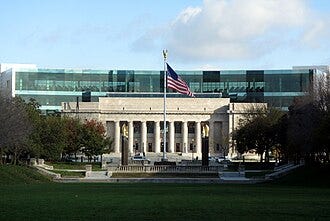
It is good to be with you, to honor your commitment to public libraries in general, and to the Indianapolis Public Library specifically. I remember when I five years old and first entered the Danville Public Library in my home town.
The library was built in 1903, a gift to our town from the steel magnate Andrew Carnegie, who called public libraries “the poor man’s college.” He built 2,507 of them around the world in such far-flung places as the Fiji Islands and New Zealand and Danville, at a total cost of $56,136,430.97, a princely sum then and now.
Our town had 1,802 citizens in 1903, but 2,000 people came to the laying of the cornerstone. I wasn’t there, but heard about it as a child from my neighbor, Mr. Hoban, who attended as a ten-year-old boy, still remembered that day, and spoke of it often.
The Danville Public Library was, and remains, a magnificent structure. The first time I saw it, I thought it was a church, because you had to be quiet there. I was further confused because the librarian, Miss Cox, lived in the home next door, which I believed was a parsonage, and that she was the pastor. She was very kind and made a strong impression on me. I talked about her so often, my mother said, “Maybe one day, you’ll grow up to do what she does.”
Because I had it fixed in my mind that she was a pastor, I became one, though I now realize my true calling was to be a librarian, and that my Holy Scriptures were the Dewey Decimal System.
Unfortunately, by the time I figured that out, I was out of seminary and in my first church, married, with a family, and it was too late to turn back. I’d gone too far down the road. I remember the exact moment I realized I’d picked the wrong vocation. I was sitting in a church meeting one evening where people were arguing about carpet color and I thought to myself, “I should have been a librarian.” Then I heard a voice. It sounded like Miss Cox, but I think it was God, (I often confused the two.) and it said, “I tried telling you through your mother, but you didn’t listen.”
Instead, I married a librarian and became a writer, knowing it would give me an excuse to spend time in libraries. Writers are viewed with suspicion by people in my town, who enjoy books, but are suspicious of the people who write them. They feel the same way about sex. It is alright to enjoy it, but you shouldn’t make it your career. Forgive me for talking about sex. I’m sorry. See, I’m a bad minister. Bad minister. I should have been a librarian, like Miss Cox.
Oh, Miss Cox. I would walk into the library and there she would be, perched on the stool behind the circulation desk, like a bluebird in a nest. She never asked anyone what they wanted. She believed the finest treasures in a library were the ones you discovered while looking for something else. She believed in letting people mine their own gold. And she was right. While searching through the Childhood of Famous American series for a biography of Babe Ruth, I unearthed a book about Ernie Pyle, who grew up on Highway 36, two counties west of our town, and became a writer, a journalist, sending dispatches home from World War II. I checked out his book. This was back in the days when the librarian wrote your name on the due date card in beautiful Palmer Method script. Miss Cox wrote my name on the due date card of Ernie Pyle: Boy From Back Home, then said, “You could be a writer.” And the seed was planted.
Ah, the due date card… Saturday mornings in the winter, walking to the library and sneaking upstairs where children weren’t allowed, to the adult fiction section. Reading the names on the due dates cards to see who’d been reading what books. That was always an education. Certain pillars of the town and church deacons checking out books Pastor Taylor at the Quaker church had warned us about. Books like Gone With the Wind, which had a dirty word in it, even though Miss Cox had crossed out the dirty word and had written the word hoot up above it, so that Rhett Butler said to Scarlett O’Hara, “Frankly, my dear, I don’t give a hoot.”
Miss Cox had a Puritanical streak. If you went to the circulation desk to ask if the library had a certain book and Miss Cox didn’t think it was a book suitable for Christian people, she would let you know.
She’d say, “We don’t have that book. This is a library, not a cesspool. If you want smut, you’ll have to go to the city.”
She’d say it in a loud voice, so people would look up from whatever they were reading and stare at you. By the time you reached home, three people had phoned your mother to tell on you.
Miss Cox attended the Quaker meeting, though it pained her to do so. Pastor Taylor would stand at the pulpit and read the Scripture and mispronounce the words, which annoyed her to no end. He would read about Jesus warning the high-po-krites to first remove the log from their own eyes, or about the ten leapers whom Jesus healed, and Miss Cox would flinch. It was not a hospitable place for literate people, but she was a fourth generation Quaker and therefore stuck with it. Becoming a Methodist was not an option. In a small town, freedom of religion and the right of free association are good in theory, but rare in practice.
I would sit in the pew behind her and listen as she cursed her ancestors. She did it very quietly, but I could hear her, and even learned some new words, which I’m not permitted to use, being a minister in a small town, though I would like to, and even have occasional fantasies about speaking freely, though mostly I keep quiet. There are lots of things you learn if you’re quiet. If you sit silently and watch people, you can learn their secrets, and store them away. Then maybe you’ll grow up to write books, and you can bring those secrets out and share them with others, after changing the names, of course, though everyone in town knows who you’re talking about.
Miss Cox is gone now, and has no descendants. At least that we know of. She never married, and had no children, but there were rumors, though I’m not one to dwell on such things. Though someday I might write a book about it, having made my peace with the half-truth, the wink, the crossed fingers. Writers make things up out of whole cloth, except we call it fiction or storytelling, making a virtue of something that would have gotten us in trouble when we were kids. Instead, publishers pay us to write more lies. Adulthood is when you learn that everything you were taught as a child was wrong. My parents said if I lied, I would end up broke and in jail. Instead, I ended up relatively prosperous, spending time with librarians.
Which is why I’m here today, to thank you for your generosity. Such an honor to spend time in libraries and with those who love them. When I was 12 years old, in the 6th grade, our school got a new librarian, Miss Huddleston, who was 24 years old and beautiful, when we first met. I was 12 and madly in love with her. I wanted to marry her. My mother said, “It won’t work out. She’s twice as old as you.” Now it’s only gotten worse. I’m 59, which makes her 118. I saw her last year for the first time since 6th grade. She looks amazing for 118. She looks like she’s in her upper 60’s. Still a lovely woman. I never should have listened to my mother.
Oh, my mother, who, when she became mad at me, would tell me I was adopted, that I had been born to the Smith family, who lived just across the street from us, and that maybe I should live with them. The Smiths had six feral children and attended the Apostolic church where they danced in the aisles and rolled on the floor, which sounded fascinating to me, certainly more lively than the Quakers.
All these memories. The carnival on the town square the second week of July. The Ferris wheel set up in front of Baker’s Hardware, which, for the week it was erected, became the highest point in our county. People would stand in line for hours for the three minutes of pure exhilaration of looking out over the town, seeing all the way to the electric star atop the silo on Beezy Gibb’s farm two miles south of town, the second-highest point in the county. I remember Mrs. Harvey, the Quaker widow who lived down the street from me and would not allow me to mow her yard on the Sabbath, but did teach me to play poker on her front porch one summer Sunday. And now Halloween is fast approaching, with its own memories. Trick or treating as a ghost but being so poor my mother wouldn’t cut holes in the bedsheets for eyes, so I would stagger from house to house, bumping into trees and stumbling into traffic.
Because we were poor and our station in life so low, my father wanted us to think we were nevertheless special, so would tell us we were related to famous people, like Cher, which, because no one knew her last name, could never be verified, but also could never be refuted. It is a lie my siblings and I have passed on to our children, our family connections with Cher and Barack Obama and Oprah and Abraham Lincoln and the Queen of England. Because really, when you stop to think about it, we’re all related. We’re all cousins. It is simply a matter of degree. Not only cousins to the famous, but to the infamous. Cousins to Donny Shaw, who I once wrote about, a boy from my hometown, who came out of his mother’s womb tattooed and smoking a Marlboro. Donny Shaw, who at the age of 14, ran off with the carnival to run the Ferris wheel. He is my kin too, and also yours. So when you read my books and essays, and it feels familiar, it is because we are all connected, all of us linked together, somehow, someway.
Thank you today for your connection to our community, your devotion to literacy, and your faithful support of America’s finest institution, the public library.
Philip Gulley is the author of the popular Harmony series and Unlearning God: How Unbelieving Helped Me Believe.
Discover my books, stories, and more by visiting Books by Philip Gulley
Contact Philip directly at philiphgulley@gmail.com
JOIN PHILIP FOR SUNDAY WORSHIP
You’re invited to join Philip and Fairfield Friends Meeting online for our worship services (Sundays 10:30-11:30 a.m. EDT) via Zoom.
https://us06web.zoom.us/j/89449897381?pwd=FebSgYxymy6rnRHMQth2DjXLfautTA.1
Meeting ID: 894 4989 7381
I like thinking that I am related to you — distantly, thank God, but still related! You are a wonderful story teller, Phil!
I remember your story about the nurse from Lubbock, Texas who was left at the alter. Best time in Santa Fe- ever!